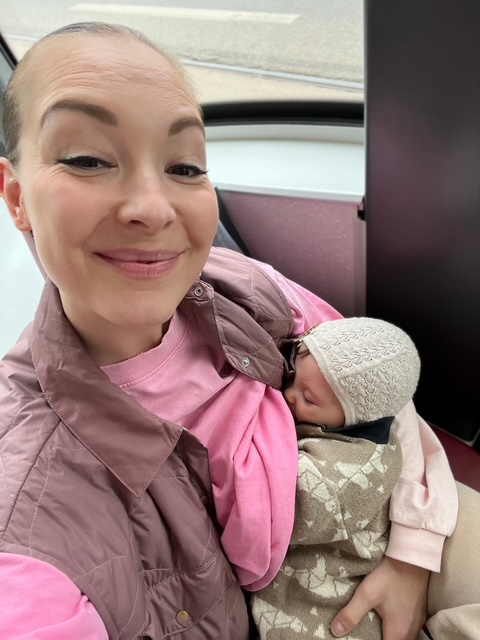
A baby in a strawberry-patterned shirt waves her arms and squirms with a wide smile. She is happy to be able to get out of the stroller and into her mother’s arms to observe the world.
For Paula Eerikäinen, motherhood is a lifelong dream that almost didn’t come true. First, the reason was the lack of a suitable partner. Then she became infected with HIV, and for a while, life seemed hopeless in many ways.
Now, with a five-month-old daughter squealing in her arms, Eerikäinen is ready to break the taboos surrounding HIV infection so that she can be a peer support for others. She refuses to be ashamed.
Shame is a big reason why I got HIV. My partner at the time either didn’t know about his infection or didn’t dare tell me. Shame has also limited me in my life, but now I want to break that harmful cycle. Eerikäinen’s daughter will later decide how openly she wants to talk about the matter. That’s why the baby’s name is not mentioned in the story.
“Who would want a partner with someone who has HIV?”
As a child, Paula Eerikäinen borrowed baby magazines and literature about childbirth from the library. She loved babies and dreamed of becoming a midwife. As an adult, the dream became stronger.
It was painful not having a partner who was ready to start a family. In the fall of 2024, after the end of a long relationship, Eerikäinen travelled to Cuba to visit friends. There, she had a relationship that lasted several months.
At the beginning of our relationship, we had discussions about both having clean records when it comes to sexually transmitted diseases. While in Cuba, Eerikäinen developed a high fever and stomach symptoms that lasted for several weeks. Locals thought she had dengue fever, and Eerikäinen did not seek hospital treatment.
Upon returning to Finland, Eerikäinen asked to have a blood test. In early December, she was sitting on a tram when the doctor called and gave her the news: Eerikäinen was HIV-positive. I got off at the next stop in shock. My first thought was that my childhood dream had gone. I really didn’t want to spread the virus, and I didn’t know what the disease would mean in my life.
Eerikäinen called two of her friends. One helped her understand that there was a lot of information available about HIV that they could learn together. The other comforted her with dark humour. At the end of the call, she said, “Well, let’s stay positive.”
Other friends and family members were equally shocked, as untreated HIV is a fatal disease. I still received full acceptance and sympathy from them. Many said that the same thing could have happened to them.
Through social media, Eerikäinen contacted a person she thought was HIV-positive. Eerikäinen told her story and admitted that she was in deep waters in thoughts. He came to me that same evening and told me that he had lived with the virus for decades. Peer support was very important at that point.
HIV medication was started quickly. After just one month, laboratory results showed that the viral level had dropped to a low level and the disease was not contagious. Gradually, I realized that HIV is no worse than other chronic, treatable diseases. I take medicine every day, but HIV does not affect my life. The doctor comforted me that my life expectancy has probably increased because I am under such close monitoring for the rest of my life.
Eerikäinen also learned that the virus would not be an obstacle to having a child. However, at that point I thought I was screwed. Who would want to partner with someone who has HIV?
About a month later, Eerikäinen ended up going on a date with an acquaintance. The man wasn’t unsure about his feelings, but HIV-related issues were on his mind. The new couple decided to go to an infectious disease doctor’s office together.
They also talked about children. Both thought that getting pregnant wouldn’t be easy. A month later, the test came back positive. That same night, the man asked his best friends to be our child’s godparents. Everyone was happy for us.
The surprises of motherhood are not related to HIV.
In recent years, approximately 250 new HIV infections have been detected in Finland each year. According to the National Institute for Health and Welfare (THL), the number has increased sharply, particularly due to migration caused by the war in Ukraine. Only one in ten new infections has its origin in Finland.
The exact number of pregnancies in HIV-positive women is not available. It is known that drug treatment during pregnancy, combined with a short period of drug treatment for the baby after birth, reduces the risk of infection in the baby to less than 1%.
Eerikäinen is not afraid that she will pass HIV to her baby. The last time there were cases of infection in mother-child pairs with a balanced treatment regimen, that is, in medicated mothers, was in Africa in the 90s. My husband and I talked about what would happen if our child got the virus. We came to the conclusion that, in that case, there would be medication that would also work for her. It brought us peace of mind.
“Right now, I’m mostly a mother, and I don’t need to be anything else.”
Eerikäinen has been met mostly well in healthcare. I’ve been thinking that not everyone there necessarily has information about it. That’s why I’m taking the initiative to tell them that I’ve been medicated, and I can’t contract the virus (U=U).
From my childhood, I remember the midwife reminding the new mother of the importance of not smoking and not using drugs. I wondered if she assumed we were drug users. I asked her directly about it, and after that she also treated us properly.
Breastfeeding was as natural to Eerikäinen as pregnancy and having a child. However, in Finland, it comes with a lot of restrictions if the mother has HIV. Continuous medication is recommended for the child during breastfeeding, and neither formula milk nor solid food should be given.
However, I felt confident about it. The milk came in well and the baby had no difficulty sucking. To be on the safe side, I have blood tests every month and the baby every six weeks.
Eerikäinen has searched extensively for information about HIV pregnancy and motherhood. She is particularly grateful to Positiiviset, which has offered her peer support, advice, and plenty of general information about the disease and life with it. Her own infectious disease specialist has also been truly encouraging.
– In Finland, the recommendations are strict, but doctors have been willing to discuss issues, seek new information, and admit if the information they have is outdated.
According to the 2BMOM study conducted in Finland, Sweden and Denmark, women living with HIV experience more symptoms of depression, stress and loneliness during pregnancy and after childbirth than women without HIV. One contributing factor is the stigma associated with the condition.
For Paula Eerikäinen, letting go of shame has played a significant role in protecting her from negative emotions. She describes HIV as a kind of superpower in her life, something that has encouraged her to pursue her dreams even more actively. While she does not feel grateful for motherhood and breastfeeding every single moment, she is careful not to take them for granted.
The challenges she has faced in early motherhood have not been related to HIV. Instead, she experienced intense baby blues in the weeks following the birth. During that time, the support of her close circle proved invaluable in helping her through a difficult period.
What did surprise her, however, was how strongly her own childhood experiences resurfaced after the baby was born. She has spent considerable time reflecting on her upbringing and on the boundaries within which it is acceptable for a mother to fall short. This process has given her a new kind of motivation to work through both her past and her present, with the aim of being a safe and supportive adult for her daughter.
Her child represents everything she has ever dreamed of. She sees both her own features and those of her loved one in the baby, which deepens her sense of tenderness and love. At this stage in her life, she feels that she is, above all, a mother, and she has no need to define herself in any other way.
The article is a direct translation of the article “Elämän mittainen unelma – Hiv ei estänyt äitiyttä” from Lapsen maailma (Elisa Miinin, 7.5.2026).